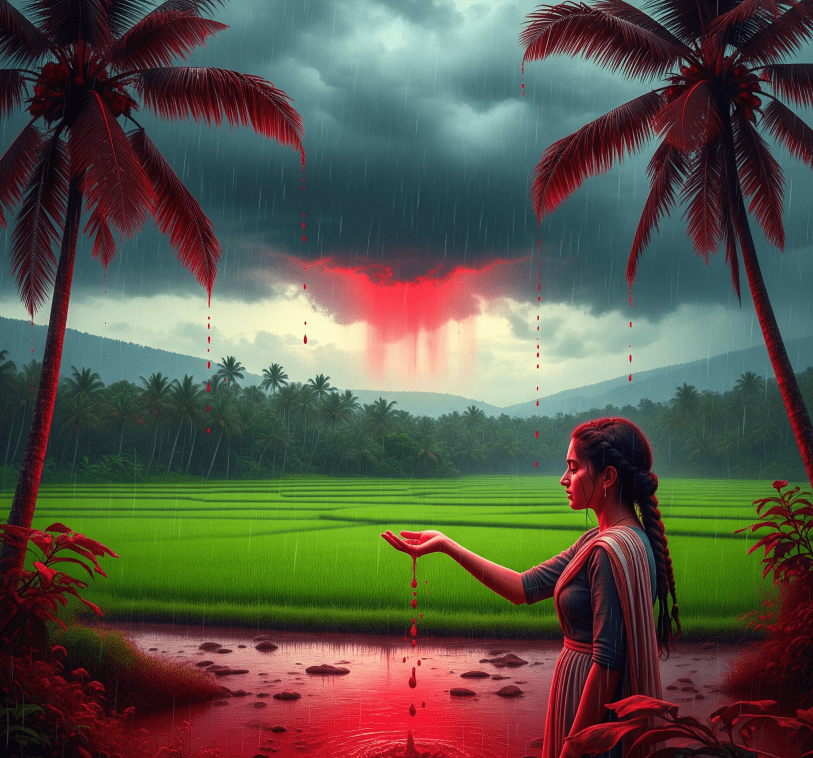
In July 2001, residents of Kerala, India, witnessed a surreal meteorological event—rain the color of blood. For nearly two months, scarlet droplets fell sporadically across the region, staining clothes, turning rivers red, and sparking widespread panic. Was it a sign of the apocalypse? A scientific anomaly? Or something even more extraordinary?
This is the full story of Kerala’s blood rain—the facts, the myths, and the scientific explanations behind one of the most puzzling weather events in modern history.
What Exactly Happened?
Between July 25 and September 23, 2001, districts in southern Kerala, including Kottayam and Idukki, experienced red, yellow, and occasionally green rain. Eyewitnesses reported:
- Clothes left outside were stained deep red
- Some heard a loud sonic boom before the first red rain
- Puddles and rivers took on a rust-colored hue
- The rain left thick, sticky residues that were difficult to wash off
Initial fears ranged from industrial pollution to biblical omens, but scientists soon stepped in to investigate.
The Leading Scientific Explanations
1. Trentepohlia Algae Spores (Most Accepted Theory)
After years of study, the Indian government and microbiologists concluded that the red particles were spores from Trentepohlia algae, a common organism in Kerala’s moist environments.
Key Evidence:
✔ The particles matched known algal spores under microscopy
✔ Trentepohlia grows on tree bark and releases airborne spores
✔ Wind and rain could easily carry them into clouds
This explanation fits most observed facts—but not everyone was convinced.
2. Extraterrestrial Hypothesis (The Controversial Theory)
Dr. Godfrey Louis, a physicist at Cochin University, proposed a radical idea: the red particles might not be from Earth.
His research claimed:
- The cells lacked DNA (later disputed)
- They could reproduce at extreme temperatures (121°C)
- Contained unusual elements like silicon and aluminum
Some speculated a meteor explosion released these particles, fueling theories of panspermia (life from space). However, later studies found fungal DNA in the samples, weakening this argument.
3. Alternative Theories (Debunked or Less Likely)
- Desert dust (Sahara/Arabia) – Ruled out because the particles were organic
- Industrial pollution – No toxic chemicals were detected
- Volcanic ash – No active eruptions coincided with the event
Blood Rain in History: Not Just a Kerala Mystery
Kerala’s case is the most famous, but colored rain has occurred worldwide:
- Europe (Ancient Times) – “Blood rains” caused by Saharan dust
- Sri Lanka (2012) – Another red rain event, also linked to algae
- Oregon, USA (2015) – “Milky rain” from dried lakebed particles
These events show that nature can produce bizarre weather without supernatural causes.
Why Does This Matter Today?
Kerala’s blood rain remains a case study in atmospheric biology. It taught scientists:
- How airborne spores can travel and affect weather
- The importance of rapid scientific response to unusual events
- How easily myths can arise from natural phenomena
While the algae theory is widely accepted, the debate highlights how much we still don’t know about Earth’s atmosphere—and beyond.
Conclusion: Mystery Solved?
Science points to Trentepohlia algae as the culprit, but the event’s eerie nature ensures its place in weather lore. Whether you see it as a quirk of nature or an unsolved enigma, Kerala’s blood rain remains one of the 21st century’s most fascinating meteorological mysteries.